When Does Bitcoin Payout Halve Again
A Bitcoin halving is when the payout for mining a new block is halved, and this happens after every 210,000 blocks (approximately four years). The get-go of which happened in 2012, and the adjacent will occur in 2024. We will discuss what happens in a Bitcoin halving, why information technology is a large deal for those involved with bitcoin mining, and its impacts on investors and the money in general.
Bitcoin Halving Nuts
To explain what a Bitcoin halving is, it is worth taking a small step back to explain the moving parts.
All cryptocurrencies using blockchains have a protocol organisation they utilize to reach an understanding between their distributed nodes to determine a single state of the network. This arrangement is chosen their "consensus mechanism." These protocols brand sure that every node is synchronized with every other node, agreeing on the transactions of a new cake, confirming that they are all legitimate, then will exist added to the blockchain.
In that location are unlike kinds of consensus mechanisms, and the Bitcoin network uses a Proof of Work (PoW) consensus machinery. Under this organisation, the distributed nodes that must gain consensus are miners who compete to confirm the new block. These machines will "mine" Bitcoins by solving complex mathematical computations that verify the Bitcoin transactions. Each device uses a brute force method to go the correct respond making millions of guesses per second to find the correct reply.
If a miner wins the race to solve the mathematical hash puzzle, then they are provided a reward. This reward is standardized past the Bitcoin network.
Hash– A mathematical part which converts an input of arbitrary length into an encrypted output (a long string of numbers) of a fixed length.
Bitcoin halving is the scheduled reduction of the miner advantage subsidy. Co-ordinate to Bitcoin'southward blockchain protocol, the Bitcoin block advantage gets cutting in half after every 210,000 blocks are created. The original reward for creating a new block, dorsum when the mysterious Satoshi Nakamoto started Bitcoin in 2008, was l Bitcoin, and over the three halvings and so far, this reward has fallen to half dozen.25 Bitcoin.
Bitcoin Halving Dates History
| Halving Year | Cake Summit | Block Reward | Date |
| 2024 | 840,000 | 3.125 | Mar 02, 2024 |
| 2020 | 630,000 | 6.25 | May eleven, 2020 |
| 2016 | 420,000 | 12.5 | July 9, 2016 |
| 2012 | 210,000 | 25 | November 28, 2012 |
| 2009 | ane (Genesis Block) | 50 | January 9, 2009 |
Data courtesy of coinwarz
The halving schedule of every 210,000 blocks is programmed into the Bitcoin source code, and the idea was for a halving to happen every iv years. This schedule is non set in stone and can be slightly different because the fourth dimension to create 210,000 blocks can vary based on how fast the miners can solve the mathematical puzzle for the hash. The mining algorithm has a target for new blocks of in one case every 10 minutes, but as more than miners bring together/leave the network the network'due south hashrate and time to solve the puzzle increases/decreases. This event is solved by updating the mining difficulty about every two weeks. The network has in full general, grown exponentially, and the average time for a new block is virtually always below the target 10 minutes. If you lot look at the by schedule, it is talking nigh iii to 4 months less than the four-year halving scheduled to complete 210,000 blocks.
What are the Furnishings of Bitcoin Halving?
The halving obviously results in a reduction of the reward for the creation of new blocks. The next halving will lower it down to 3.125 Bitcoin.
Mining
Bitcoin mining involves large companies or groups working together to share the Bitcoin rewards. The hardware is purpose-built for mining Bitcoin, and depending on the network'due south hashrate, and hashrate of the miner will determine the average acquirement they can generate. Miners also need to cistron in their energy costs.
Hashrate– is a measure of how many calculations (guesses of the hash) can be performed per second and can exist measured in billions, up to quintillions. A hashrate of 1TH/southward = one trillion calculations per 2nd.
For anyone in the mining business, a halving is a significant event because what you were making concluding week is now half this calendar week. Imagine if a golden mine knew that the gold it was pulling out of the ground would exist halved every four years. Bitcoin miners' costs remain the same; notwithstanding, their revenues go downwardly past about half. With halvings, there are often a small group of miners that no longer think it is viable for them to be mining, and they volition leave to employ their rigs for mining other cryptos. This does lower the network's hashrate to a pocket-size degree which is a positive for the miners who choose to stay simply does not make upwardly for the loss of income.
Bitcoin Halving Economics
The halving reduces the new money creation rate lowering the supply, and halvings usually bring a lot of press and new buyers, which increases supply. This has had implications for investment similar to other assets with finite or low supplies, such as precious metals, which have higher need and prices are pushed college.
Bitcoin has a fascinating aggrandizement curve:
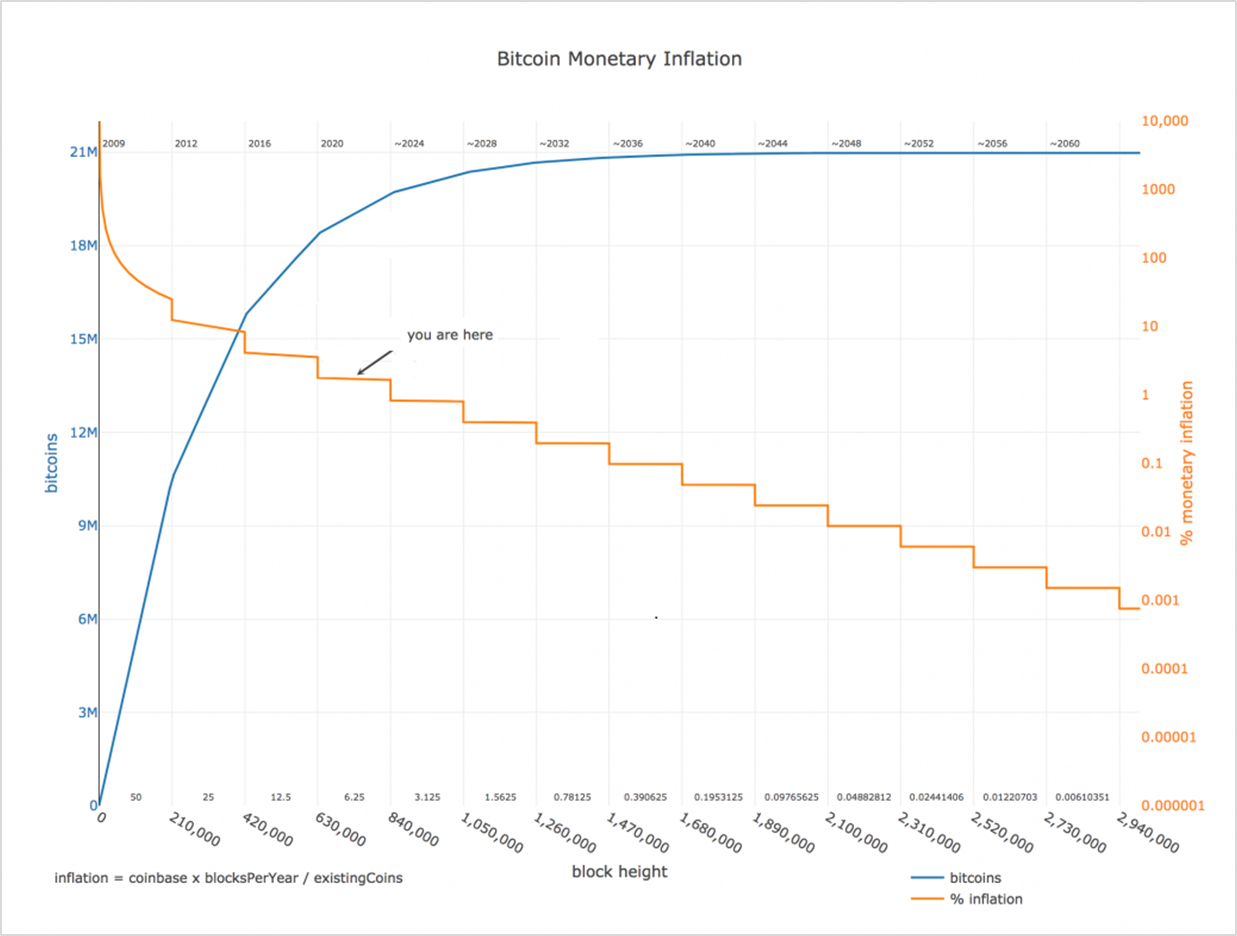 Image property of the author
The blue line shows the full supply of Bitcoin, which in 2022 stands at well-nigh 19 million. Every day Bitcoin inches closer to its maximum of 21 million full supply (around the year 2140). The orange line is the inflation rate of Bitcoin that every four years (each halving) decreases by half. The current charge per unit is below 2% and will continue to fall with every new block and halving.
The known supply, maximum time to come supply, and creation rate over fourth dimension it will take to become there are standardized with halvings, making predictions stable with Bitcoin, unlike fiat currencies that are controlled only by the whims of governments and their cardinal banks. This is the main reason that Bitcoin is considered a great Store of Value by proponents, including Goldman Sachs.
Investment
For investors of Bitcoin, nosotros tin can look at the past to help us predict how the 2024 halving volition affect the cost of Bitcoin. Bitcoin halvings of the by have resulted in massive cost surges. The 2012 halving saw Bitcoins price jump from $12 to $1213 in the following year. The second 2016 halving price was at $647, and the year that followed saw it go to $xix.800 but then fell back to $3,276 some other twelvemonth later, withal 506% above its halving cost. Bitcoin'southward most recent halving was in May of 2020 when the cost stood at $8,787, and in 2021 the price hit over $68,000, from which we have fallen back to $42,000, upwards 377%.
When nosotros look at the by halvings (on a log scale), these patterns are piece of cake to recognize. The price of Bitcoin goes up dramatically after the halving, but at that place follows an extended carry market before going back up again at the next halving.

Nosotros tin can see this trend continued.

The percent increment afterward the halving is falling with time, and considering this design has been recognized past many, the next halving may accept a totally different result.
The Theory Behind Halving
The theory of halving is that the following chain reaction would occur:
Reward is halved → inflation halved → reduced bachelor supply → increased demand → price increase→ miners' incentive remains, regardless of smaller bounty, increasing Bitcoin's value in the process
If demand and toll are not increased with the halving, miners will all quit considering the advantage is smaller, and Bitcoin's value doesn't increase. However, at that place is a mechanism to assist. If the reward is halved and Bitcoin's value does not increase, the mining difficulty can be contradistinct to make mining easier. This means that the reward remains the same, merely the processing difficulty is too reduced.
Three halvings have proven successful, with simply a few miners quitting because Bitcoin'south price increased more making up for the initial acquirement loss. The crashes after the approximate one-yr runup have maintained prices higher than when the halving event was completed.
What's Next?
If the past trend continues, we have probably reached the post halving 1-year runup (from the 2020 halving) and the all-time high that will exist seen before the side by side 2024 halving. The question remains if the 2024 halving volition lead to a massive runup subsequently it comes or if a runup will begin earlier the halving with investors wanting to take advantage of the expected runup pattern. What may eventually happen is that there is a smoothing of the entire pattern. Looking at the historical returns, it seems that the huge gains are lessening with each halving, and this smoothing might exist the result. Just time volition tell, and the fourth dimension to watch for is prior to the coming March 2024 halving.
Disclaimer: The author of this text, Jean Chalopin, is a global business leader with a background encompassing banking, biotech, and entertainment. Mr. Chalopin is Chairman of Deltec International Group, www.deltecbank.com.
The co-author of this text, Robin Trehan, has a Bachelor's degree in Economics, a Main'southward in International Business and Finance, and an MBA in Electronic Business. Mr. Trehan is a Senior VP at Deltec International Group, www.deltecbank.com.
The views, thoughts, and opinions expressed in this text are solely the views of the authors, and practise not necessarily reflect those of Deltec International Group, its subsidiaries, and/or its employees.
Source: https://www.deltecbank.com/2022/02/28/bitcoin-halving-2024/?locale=en

Post a Comment for "When Does Bitcoin Payout Halve Again"